 World
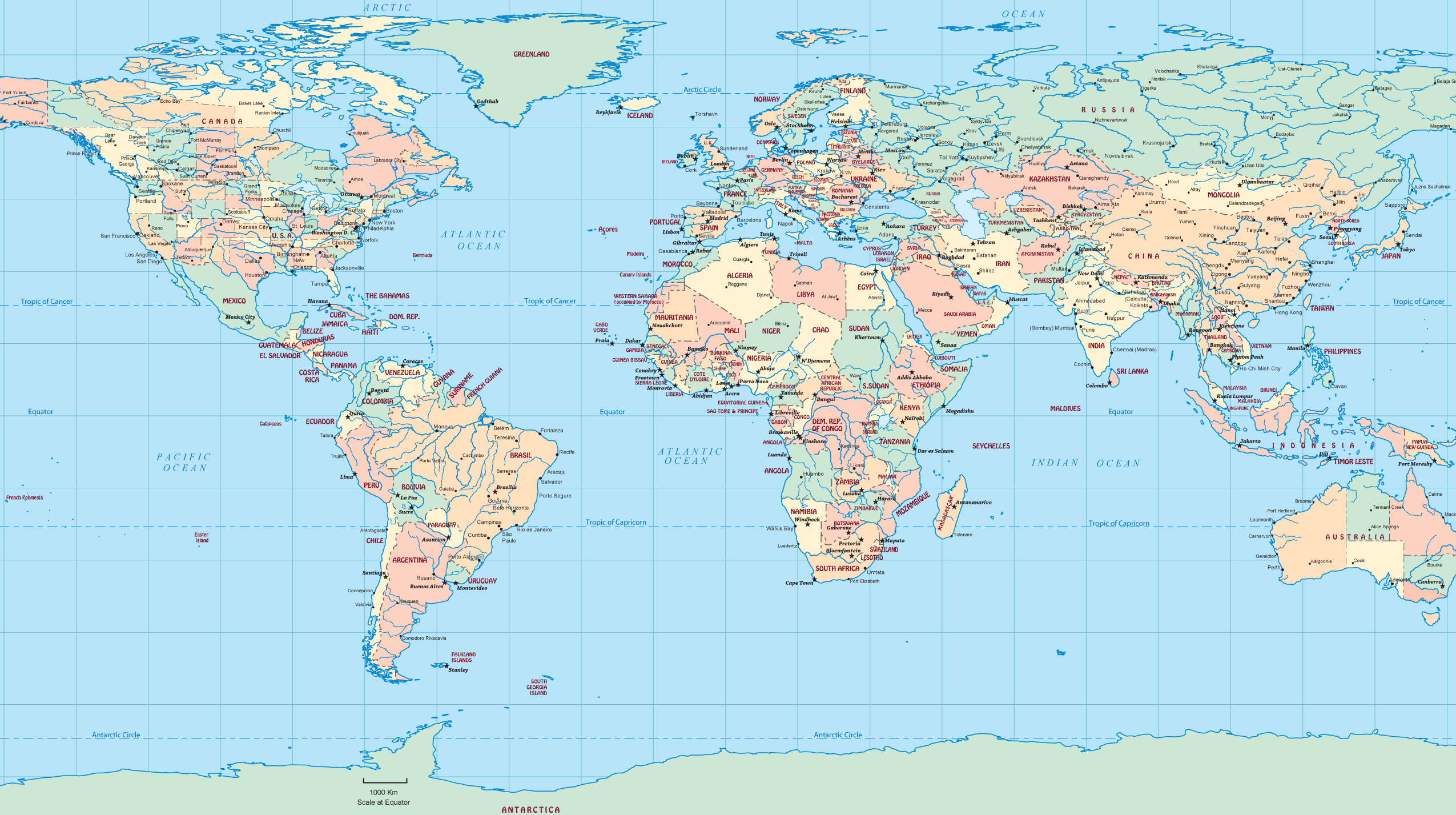
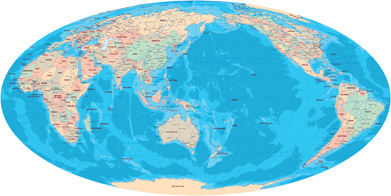
Map using the Plate Carrée cartographic projection, with Africa in the center.
The projection was invented by Marinus of Tyre (c. 70–130) around A.D. 100.
Marinus was born in Tyre (now in Lebanon) in the Roman province of Phoenicia. He
founded the mathematical geography, which provided the basis for Claudius
Ptolemy's Geography.
World
Map using the Plate Carrée cartographic projection, with Africa in the center.
The projection was invented by Marinus of Tyre (c. 70–130) around A.D. 100.
Marinus was born in Tyre (now in Lebanon) in the Roman province of Phoenicia. He
founded the mathematical geography, which provided the basis for Claudius
Ptolemy's Geography.
The Plate Carrée projection is an equidistant cylindrical projection with the equator as the standard parallel. A grid of parallels and meridians forms perfect squares. It is one of the simplest and oldest cartographic projections. The radius is used as a conversion factor between angular and linear units. This projection is equidistant along any meridian and the equator. Shape, scale, and area distortion increase with the distance from the equator. North, south, east, and west directions are always accurate, but general directions are distorted, except locally along the equator. Distortion values are symmetrical across the equator and the central meridian. In oblique aspects, all vertical lines are equidistant when used with sphere-based Earth models.